


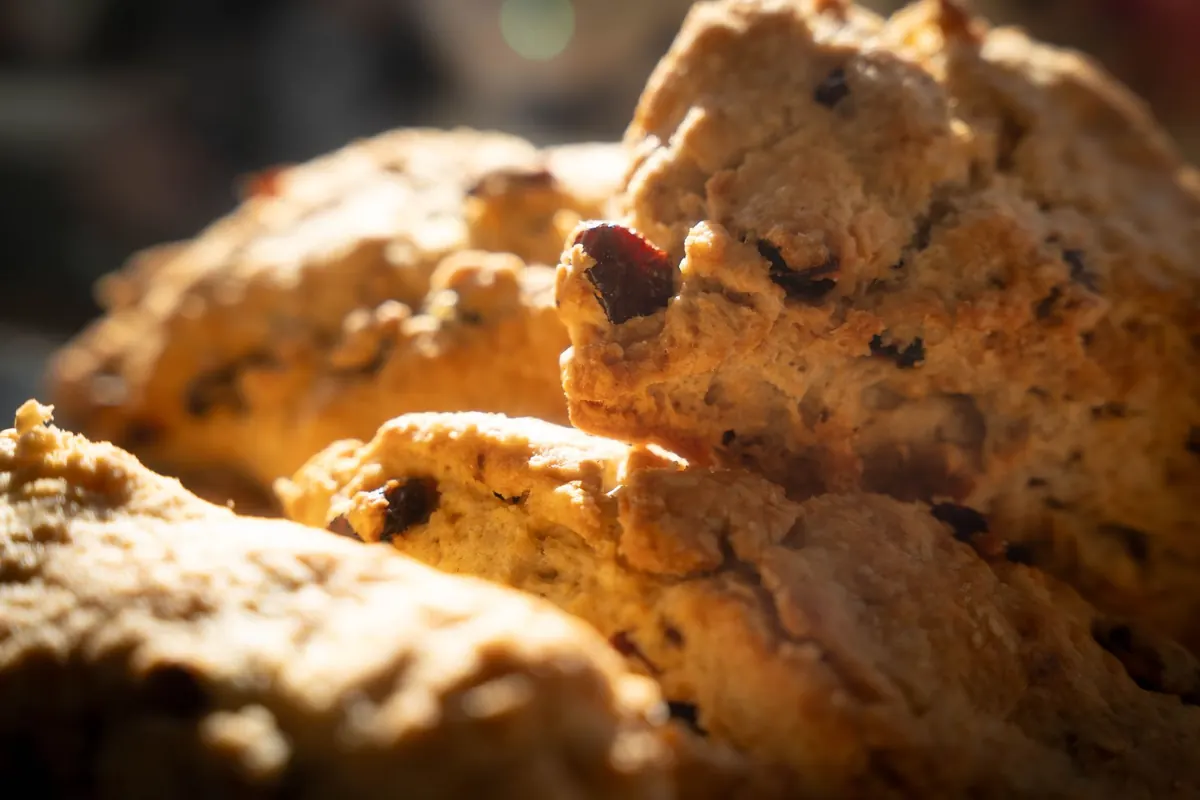
The scone arrives still warm, wrapped in a napkin or sitting naked on a white plate. Next to it: a small pot of strawberry jam and a dish of clotted cream with a golden, slightly cracked crust. Someone at the table will now ask the question that has divided Devon and Cornwall for generations. In Devon there is a correct answer, and locals will give it to you without hesitation.
None of this is a rulebook for its own sake. A cream tea eaten the right way simply tastes better, and it saves you the small, kind corrections that tearoom staff have perfected over decades.
In Devon, the Jam Goes On First
Cornwall spreads cream first and jam on top, reasoning that cream does the job of butter. Devon does the opposite: a layer of jam, then a generous spoonful of clotted cream over it.
The Devon order is practical as well as traditional. Jam grips a crumbly scone and gives the cream something to sit on. The cream — thick, faintly sweet, more yellow than white — stays in a soft mound on top where you can taste it, rather than smeared thin under a layer of slipping jam.
Do it the Cornish way in a Devon tearoom and nobody will throw you out. You may be quietly noted, though. It sits in the same category as putting milk in before the tea: not a crime, but a thing people notice.
How to Build the Scone, Step by Step
If you remember only one sequence, remember this one.
- Start with the scone. Plain or fruit, warm rather than fridge-cold. Fruit scones usually mean raisins or sultanas, sometimes mixed peel.
- Split it horizontally. One cut through the middle, with your fingers or a knife. Do not saw it into three slabs like a cake.
- Jam both halves. A heaped teaspoon per half, spread close to the edges. A thin, even layer is the aim — you are flavouring the scone, not making a jam sandwich.
- Cream on top of the jam. A dessertspoon per half, dolloped rather than flattened. Leave the golden crust in place; it is the best part.
- Do not put it back together. Two open halves, both topped, is the finished article.
- Eat from one end so every bite has scone, jam and cream in roughly the right proportions.
If you have ordered two scones, build one at a time. A scone assembled twenty minutes ago has gone heavy and damp.
Clotted Cream Is Not Whipped Cream
This is where visitors from outside the West Country most often go wrong, usually without realising it. Clotted cream is made by gently heating cream and letting it form a thick, buttery layer with a crust on top. It is dense enough to stand up on a spoon and rich enough that a little goes a long way.
Squirty cream from a can is not a substitute. Nor is whipped double cream, and nor is crème fraîche, however good that is with a pudding. If you are assembling a cream tea at home, buy clotted cream — it is widely stocked in British supermarkets and turns up in specialty shops abroad. Keep it chilled, but take it out of the fridge twenty minutes before serving so it spreads instead of tearing the surface of the scone.
On the crust
Some people stir the crust into the cream; others lift it off and keep it for the last scone. Both are acceptable. Leaving it behind on the dish is not.
Six Mistakes Visitors Make
- Cream first. The most common error, and the one most likely to prompt comment.
- A cold supermarket scone. The scone is half the point. Buy from a bakery or a tearoom that baked that morning.
- Making a sandwich. Pressing the loaded halves back together flattens the cream and squeezes jam out of the sides.
- Cutting wedges. A scone is not a cake. Splitting it is quicker and gives a better ratio.
- Asking for butter. Clotted cream is already doing that job.
- Skipping the tea. A coffee alongside misses the balancing act. Tea cuts through the fat of the cream, which is exactly why the combination exists.
The Tea Part Matters
Brew it strong enough to hold its own against cream and jam. An English breakfast blend or a Devon blend works well; anything delicate and floral gets lost. Add milk to taste once the tea is in the cup — the old milk-first rule was about protecting fine china, not flavour, so with a sturdy mug it makes no difference.
If the tearoom offers loose leaf, take it. Strain properly, and do not leave the leaves sitting in the pot for the second cup or the tea turns bitter. Let the first cup cool for a minute before drinking. The cream deserves your attention.
Where and When to Eat One
Tearooms in the Dartmoor villages are the classic setting — Widecombe-in-the-Moor, Chagford, Moretonhampstead — along with church halls, National Trust properties and farm shops with a few tables out the front. Coastal towns do them well too, particularly out of season when you can get a window seat.
The traditional slot is mid-afternoon, but most places serve cream teas from late morning until the scones run out. A cream tea is one or two scones with jam and clotted cream and a pot of tea. Afternoon tea is a larger affair with sandwiches and cakes. Do not order a cream tea expecting three tiers, and do not order afternoon tea if all you want is a scone.
One
Photo: James Collington / Pexels
Related posts
More stories you’ll love reading